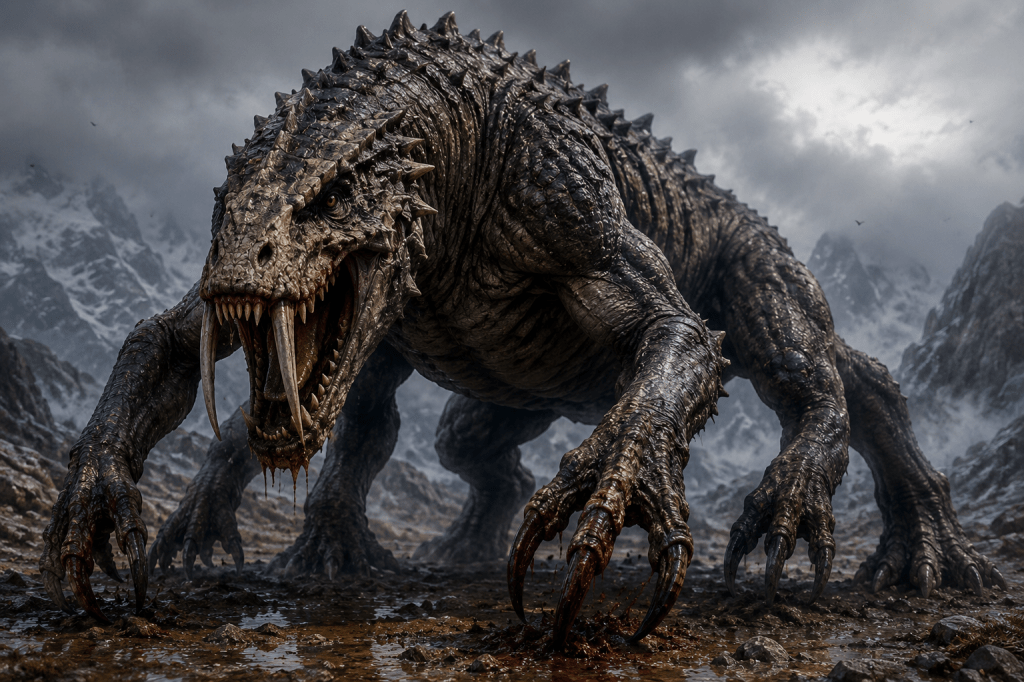
There are creatures that hunt because they are hungry… and then there are creatures that hunt because the world itself fears them. The Grovakk belongs to the second kind.
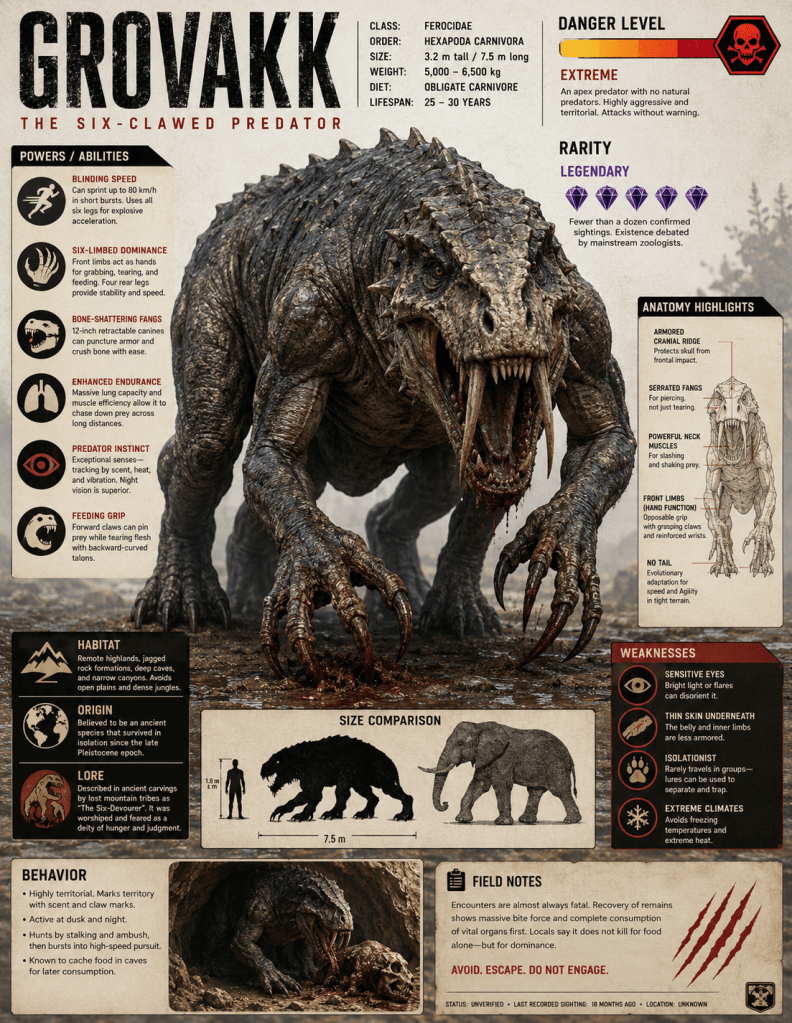
Towering nearly the size of an elephant, this six-legged predator is considered one of the most dangerous beasts ever recorded in the wild regions of the northern highlands. Travelers describe it as a nightmare made flesh — a creature with the face of an ancient reptile, massive curved fangs, and a body built entirely for speed and violence. What makes the Grovakk truly terrifying is not just its size, but how unnaturally fast it moves. Witnesses say it crawls low to the ground like a stalking insect before suddenly exploding into a sprint powerful enough to shake the earth beneath it.
Unlike most predators, the Grovakk uses its front limbs almost like hands. It tears apart prey with frightening precision, gripping bones and flesh while its enormous jaws crush through armor, shields, and even stone-like shells. Hunters who survived encounters often speak about its intelligence more than its strength. The creature does not rush blindly into battle. It studies. Watches. Waits.
The Grovakk prefers isolated mountain valleys, cave systems, and rocky wastelands where fog and darkness hide its movements. Entire villages have disappeared near territories believed to belong to one. Ancient carvings discovered in ruined temples portray the beast as a guardian of death and famine, worshipped by forgotten tribes who believed the creature could judge human souls.
Despite its brutal appearance, there is something strangely fascinating about the Grovakk. It feels less like an animal and more like a surviving relic from another age — a living weapon left behind by a world far older and crueler than our own. Some scholars even believe the species should have gone extinct centuries ago, yet sightings continue to emerge from remote regions every few decades.
Perhaps the most chilling detail is this: nobody has ever confirmed how many Grovakks still exist.
And maybe humanity is safer not knowing.
 Pot of plot
Leave a comment